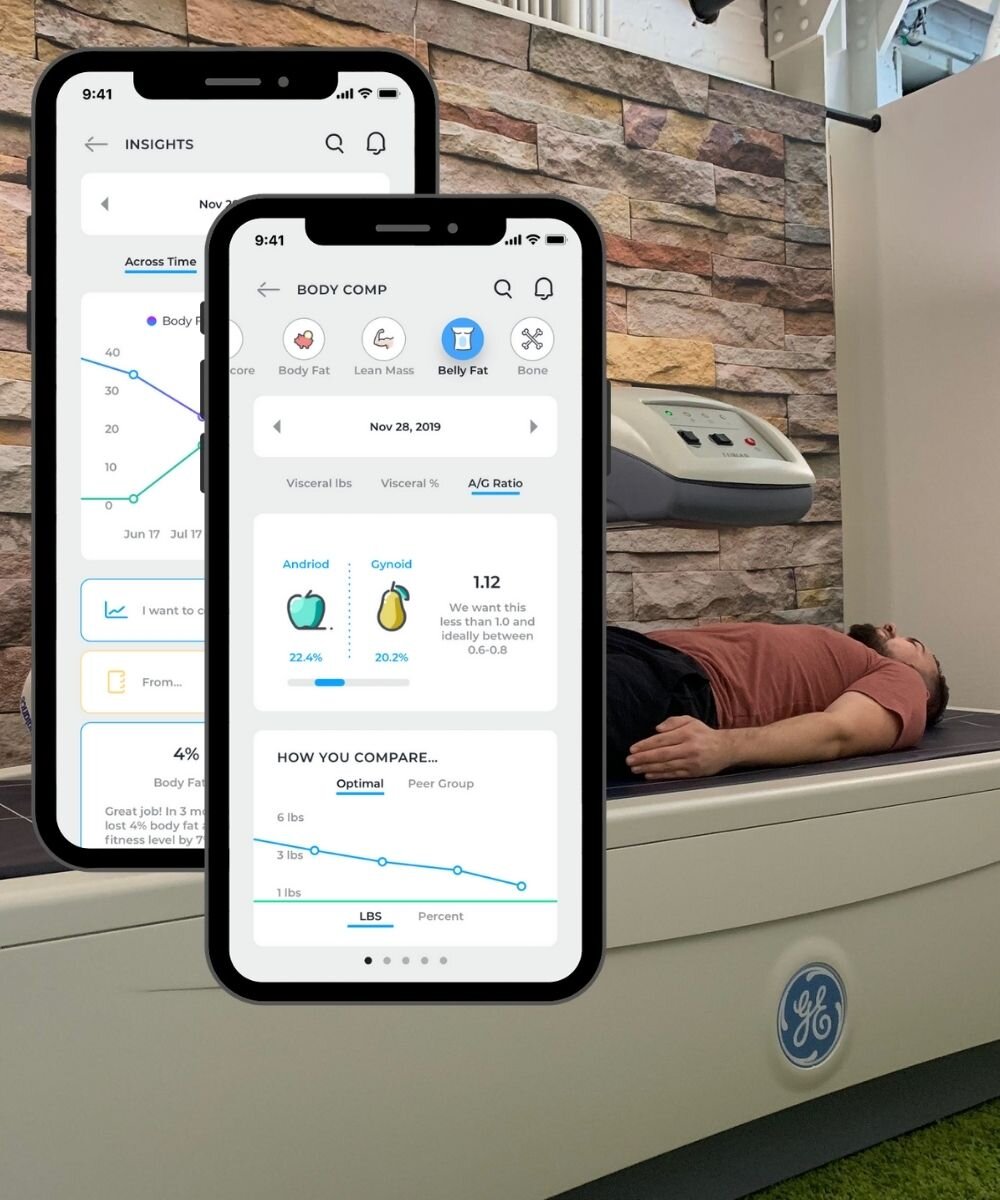
The Technology Behind the
Dexa Fit Body Scans
Procedure
Compared to other methods of body composition testing, DXA requires little client participation. Just come to the office with casual workout wear (no zippers, studs, or snaps), lay down on the scanning table, and four to six minutes later, you’re done. If you accidentally wear something with metal on it, we’ll supply you with scrubs to change into.

DXA:
Dual-energy X-ray absorptiometry yields accurate measurements of bone mineral, fat, and lean soft tissue mass—making it a more attractive alternative to other methods of body mass analysis.
Recognized as the leading reference method for body composition research, DXA is safe, convenient, and requires minimal client cooperation.
The basic principle underlying DXA technology is that the attenuation of X-rays with high and low photon energies is measurable and dependent on the thickness, density, and chemical composition of the underlying tissue. This attenuation (or “weakening”) of X-rays through fat, lean tissue, and bone varies due to the difference in the densities and chemical compositions of these tissues.
What Does This All Mean?
The DXA scan accounts for these tissue variations, and accurately measures:
- Fat mass: all the fatty tissue in the body, including fatty tissue found within the organs of the body (visceral fat), along with the subcutaneous fat located under the skin
- Lean mass: the sum of all muscle and soft organ tissue
- Bone mineral content (BMC): the sum of all skeletal tissue within the body
- Lean + BMC: the sum of lean and BMC mass, which offers a quick assessment of change over time (as the BMC is a relatively constant variable)
- Bone mineral density (BMD): the amount of bone mineral content within a specific area
- Percent fat: the ratio of fatty tissue to total body tissue
- Regional values: technicians can produce values for individual regions of the body along with whole body results—something that no other measurement method can provide
Android and Gynoid fat % and ratio: these two regions of the body are great indicators of overall health—highly correlated to heart disease risk, insulin resistance, hormonal profile, and more
DXA vs Other Popular Methods of Body Fat Testing
Compared to other methods of body composition analysis, DXA separates itself from the Bod Pod, Underwater Weighing, and other two-compartment models by offering a more accurate and consistent body fat percentage measurement. It uses a three-compartment model—detailing fat mass, lean mass, and bone mass—and it estimates your fat and lean mass for individual limbs and regions of the body, including your gynoid and android region. No other method can provide you with such valuable information for tracking your health and body composition changes overtime.
Two-Compartment Models: Measurements divide the body into a fat component and fat-free component
Bod Pod: The Bod Pod uses computerized sensors to measure how much air is displaced while a person sits in a ‘pod-like’ capsule (see image above). This number is then used to measure body volume and to calculate estimated body fat. It a quick and accurate method for body fat analysis with validated scientific studies, but with a few notable weaknesses:
Bod Pod Weaknesses:
- Compared to DXA and even Underwater Weighing, there are more variables that can affect results: facial hair, body temperatures, moisture, and even the tightness of the spandex or swimsuit worn during the test
- Bod Pod tests are also more prone to errors when tracking changes over time
- Requires participants to sit in tight space, wearing nothing but a swim cap and tight spandex shorts or bathing suit
- Only offers Two-Compartment Model of fat and fat-free mass estimates
Underwater Weighing (a.k.a Hydrostatic Weighing): Long considered the “gold standard” of body composition testing, Underwater Weighing is a method that weighs you in an underwater tank (see image above), while simultaneously measuring the amount of water you displace (which provides your body volume—or the amount of space your body takes up). Fat-free mass is more dense than fat, so it weighs more for a given volume. Additionally, fat tends to float in water, while fat-free mass tends to sink. These principles account for your body density calculation, which is used to estimate fat and fat-free mass. The Bod Pod is based on a similar principle.
Underwater Weighing Weaknesses:
- Many participants find it difficult, cumbersome, and uncomfortable to sit totally submerged in a tank of water
- Only offers Two-Compartment Model of fat and fat-free mass estimates
- Even under absolutely perfect circumstances, there are still sources of error with Underwater Weighing. The biggest source is the conversion of body density into a body fat percentage. The Siri Equation —used most often—assumes that fat-free mass has a certain density. However, research shows that the density of fat-free mass can change depending upon your ethnicity.
- A simple change in your body weight can also change the density of your fat-free mass
- Your hydration status can change the outcome of your final body fat percentage number too.
Other Methods:
Bioelectric Impedence (BIA): Bioelectrical impedance measures the resistance of body tissues to the flow of a small, harmless electrical signal. The proportion of body fat can be calculated as the current flows more easily through the parts of the body that are composed mostly of water (such as blood, urine & muscle) than it does through bone, fat or air. It is possible to predict how much body fat a person has by combining the bioelectric impendence measure with other factors such as height, weight, gender, fitness level and age.
BIA Weaknesses:
- The impedance measure is affected by body hydration status, body temperature, time of day, and therefore requires well controlled conditions to get accurate and reliable measurements. If a person is dehydrated, the amount of fat will likely be overestimated
Skinfold/Caliper Measurements: See FAQ